The EDC: putting study build in the hands of people who are not engineers
A form builder, an edit check library, a monitoring workflow and a database lock. The product decision was who gets to use them.
The real bottleneck
In most clinical data operations, setting up a study means writing a specification and waiting for engineering to build the forms. Every protocol amendment means waiting again. The data manager, who knows exactly what the form should look like, is the one person who cannot change it.
That queue is where study timelines die. So the EDC was built around a different premise: the people who understand the protocol should build the study themselves.
What that required
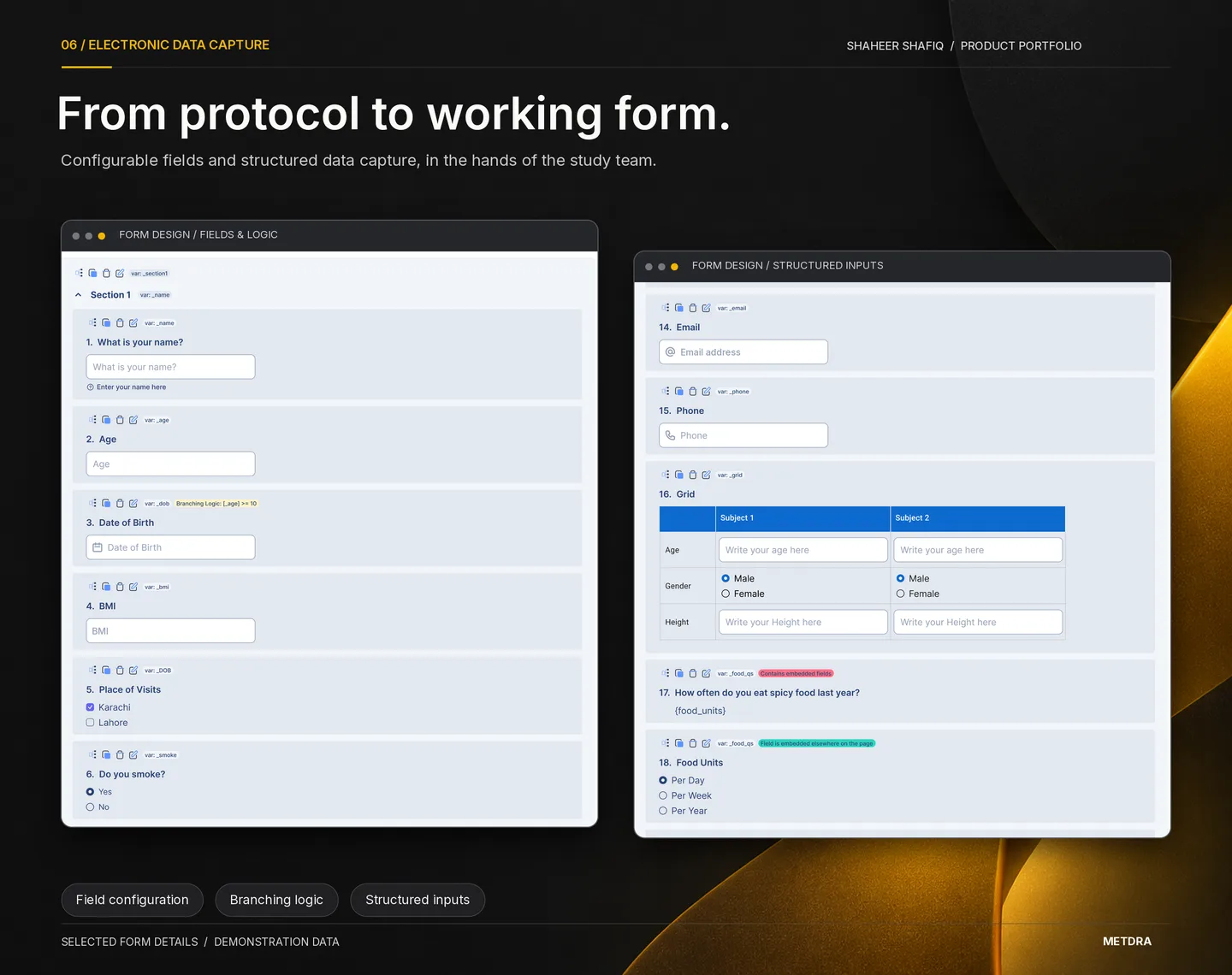
A form builder a data manager can actually use. Field types, validation, branching logic, repeating sections and visit scheduling, all configurable without touching code. The hard part was not the builder. It was deciding what to refuse to make configurable, because every option you expose is an option somebody misconfigures at two in the morning before a site goes live.
An edit check library instead of edit checks. Teams kept rewriting the same range checks, date logic and cross-form consistency rules for every study. Making them reusable turned study build from authorship into assembly, and it meant a check that had already survived one study's data was reused rather than reinvented.
Monitoring built into the same object. Source data verification is not a separate activity bolted on afterwards. Monitors review, raise queries and sign off against the same records sites entered, with the full audit trail intact. One system, one truth, no reconciliation.
Reporting that answers operational questions, not just scientific ones. Query ageing, enrolment by site, overdue forms, outstanding verification. The reports a study manager needs on a Monday morning, not the exports a statistician needs at the end.
Database lock, the part nobody enjoys
Lock is the hardest feature in an EDC because it is the only one that is irreversible and the only one where being wrong is expensive in a way you cannot undo.
The design principle was that the system should make lock a consequence rather than an event. Outstanding queries, unverified records, unsigned forms and missing pages all surface continuously, so the state of readiness is visible for weeks beforehand rather than discovered in a panic the week of lock. The lock action itself then becomes a confirmation of something already true.
Unlock exists, requires explicit authority, and leaves a permanent record. It is designed to be uncomfortable, because it should be.
The trade I keep making
Every request to add flexibility to the form builder is also a request to widen the surface where a study can be misconfigured. Every request to add a guardrail is a request to make somebody's legitimate edge case impossible.
My default has been to say no to configurability that only one study needs, and to absorb that study as a one off rather than permanently complicate the tool for everyone else. A builder that is simple enough to be used correctly is worth more than a builder that can express everything.
What changed
Study setup moved off the engineering backlog. Protocol amendments stopped requiring a release. The team that understands the protocol now owns the artefact that encodes it, which is where that ownership always belonged.
Inside the platform
Inside this workflow
Real interfaces with demonstration data. Select a screen for a closer look.
From protocol to working form.
Configure fields, branching logic and structured inputs.
Keep every query in view.
Follow data queries through resolution.
Reporting with a clear owner.
A reporting workspace with visible responsibility and access.