The unglamorous half: documents, subjects, budget and people
Four modules nobody demos. Without them the platform is a data system, not a system a research organisation can run on.
Why these exist
Every platform has a demo half and an operational half. The demo half gets the conference slot. The operational half is what decides whether an organisation can actually run on the product.
Four of these were mine to scope, and each one is a lesson in deciding how much to build.
Document management
A trial master file is not a folder of PDFs. It is a defensible claim that the right document existed in the right version at the right time, and that you can prove it.
The build was structured around that claim rather than around storage. Documents sit against a study, a site and a document type with an expected set, so what is missing is as visible as what is present. Versioning is enforced rather than conventional, because a shared drive with "final_v3_REALFINAL" in it is not a trial master file. Access is scoped by site, so a site sees its own documents and nothing else.
What it deliberately does not do is try to be a general document management system. It knows about trial documents and nothing else, which is why it is usable.
Subject logging without touching the data layer
Coordinators needed a working view of who is enrolled, who is screened, who is due and who withdrew. The obvious answer is to give them access to the subject data.
That answer is wrong. Every additional person with access to the clinical data layer widens the compliance surface, the training burden and the audit scope, for a need that is essentially a worklist.
So subject logging is a deliberately superficial layer: enough to manage the day, with no route into the underlying data. The restriction is the feature. It gave coordinators what they needed while keeping the number of people who can reach clinical data as small as it should be.
Budget at a deliberately shallow level
Study budgeting was scoped at a high level on purpose. Precise cost tracking means integrating with finance systems, matching invoices and owning a reconciliation process nobody had asked for and nobody wanted to maintain.
What the business actually needed was visibility: what a study was expected to cost, where it stood against that, and which studies were drifting. That is answerable at a coarse grain and useful immediately. Anything more precise would have been a finance product wearing a clinical product's clothes.
Saying no to the deeper version was the correct decision and the unpopular one.
Workforce management
A contract research organisation runs on people, and staffing is a study variable in the same way supply is. Who is assigned, what their qualifications and training records are, where their capacity sits across studies.
The reason this belongs in the platform rather than in a general HR tool is training. Qualification and training currency are inspection items, tied to the study and the role, and keeping them in a separate system means keeping them twice.
The pattern across all four
In each case the hard call was not what to build. It was how far to stop. These modules are each a fraction of the product they could have grown into, and that restraint is why the platform shipped eight modules instead of three very good ones and five unfinished ones.
Inside the platform
Inside this workflow
Real interfaces with demonstration data. Select a screen for a closer look.
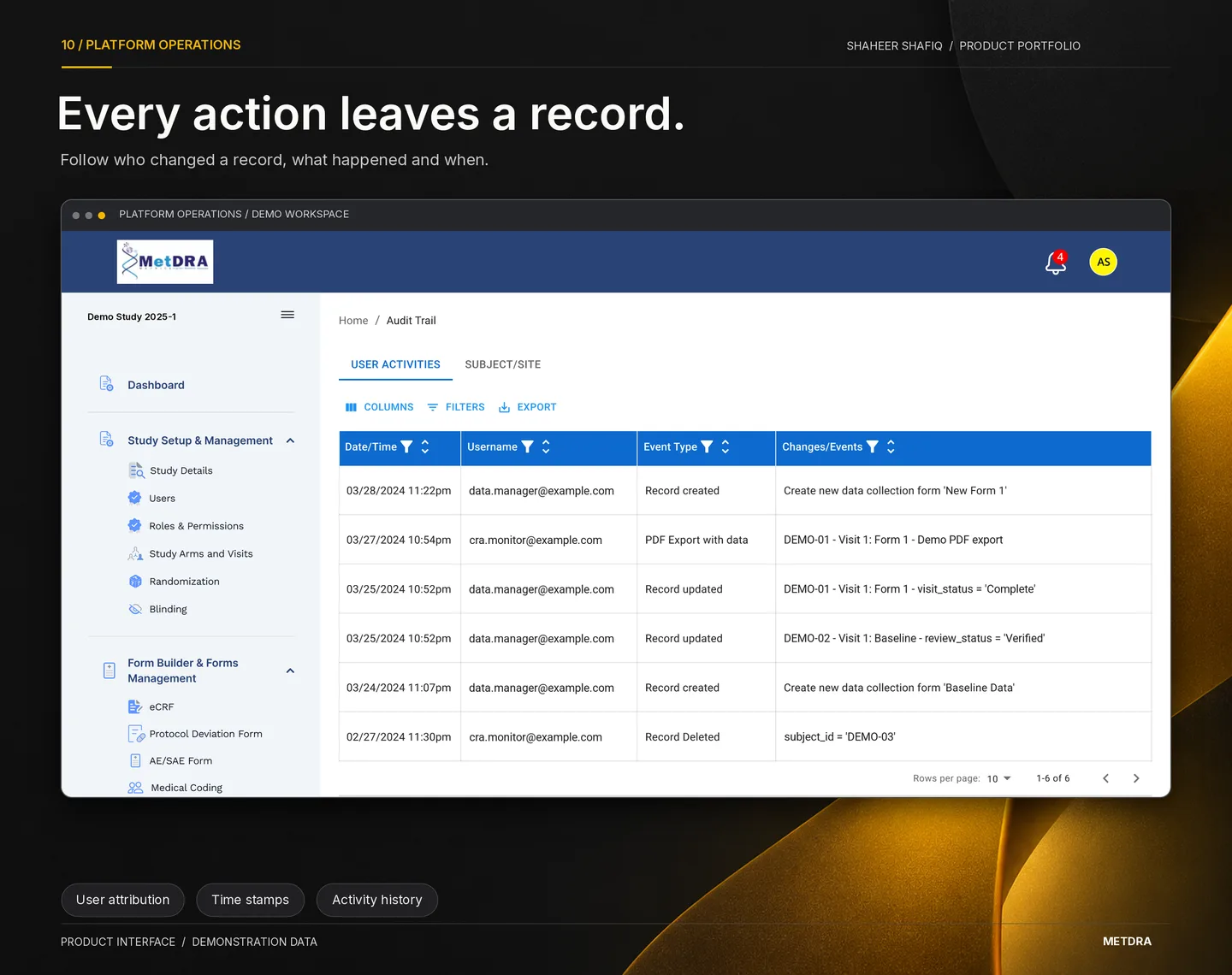
Every action leaves a record.
Follow who changed a record, what happened and when.